
 Register here
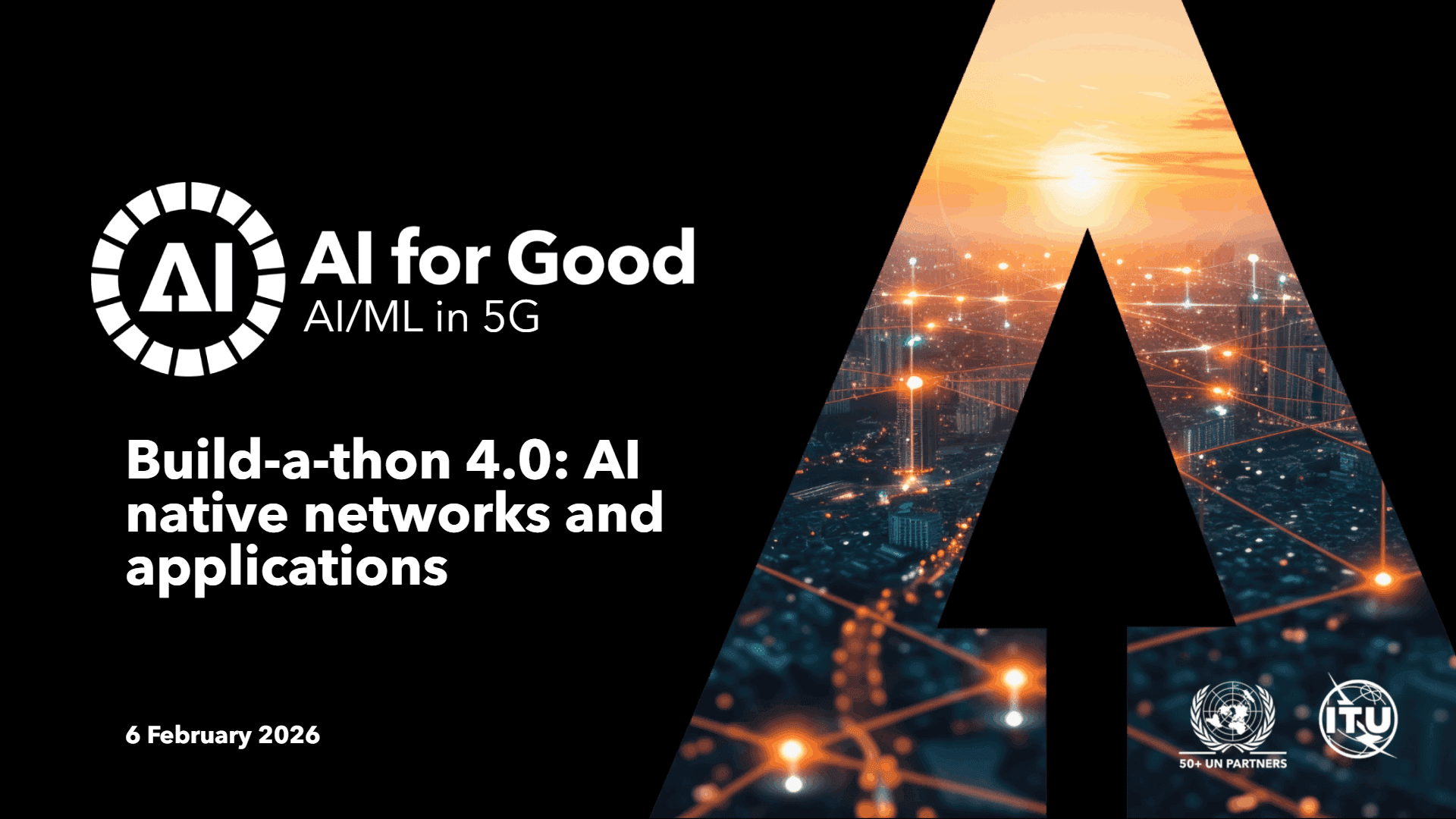
The Build-a-thon model successfully conducted in earlier ITU Focus Groups such as FG-ML5G and FG-AN, and further demonstrated through the three Build-a-thons already organized under FG AINN has proven highly effective in energizing FG members, academia, startups, and the broader community. The build-a-thon 4.0 is an official Pre-Summit Event for affiliation under the India – AI Impact Summit 2026, focusing primarily on the Main Theme: AI-Enabled Smart Broadcasting, encouraging participants to design and demonstrate AI-native solutions that advance intelligent, scalable, and efficient broadcasting systems.
The broad objectives of the Build-a-thon are:
- Analysis of AI-Enabled Smart Broadcasting and other AI Native solutions for telecommunication networks use cases, requirements and foster awareness on the FG activities.
- Derive new contributions for the FG-AINN in the areas of:
- Explore practical feasibility and trade-offs of AI-Enabled Smart Broadcasting and other AI-native networks via PoCs for specific use cases and architecture concepts.
- Facilitate hands-on engagement through crowd-sourced coding and development activities.
- Engage stakeholders in discussions and collaborations to advance AI-native networks, especially a crowd-sourced coding activity involving academia, industry and start ups.
Participation in the Build-a-thon is divided into the following stages:
Stage-1. Demo proposals: these are proposals which clearly explain the concept chosen for demo, relation with AI-Enabled Smart Broadcasting and other AI Native networks, including alternatives and trade-offs for studying and implementing them. Background study supporting the proposal should be added and hypothesis on the target conclusions, based on currently ongoing studies in the domain of AI enabled broadcasting and AI Native Networks can be clearly mentioned in the proposal.
Stage-2. Implementation proposals: these are proposals which clearly explain the implementation approaches in detail, including the test setup, base code to be used (if any), mapped to the demo proposal in (1) needs to be added. Functional and performance requirements corresponding to the demo, any datasets needed, toolsets including opensource or proprietary, and test cases which correspond to requirements needs to be added at this stage.
Stage-3. Initial implementation of the demo: these implementations actualize parts of the implementation proposal in (2). The initial implementation may not be complete nor final, but clearly shows the progress towards completion. The pass/fail status of the testcases in (2) shall be added in the submission. Plan towards final demo would added in relation to the current status of the initial implementation.
Stage-4. Final demo and report: A contribution in the template of FG AINN, collating the relevant items from (1), (2) and (3) above, specially highlighting the lessons learnt on the feasibility of the design and that of the chosen implementation approach. A demo presentation, show casing the test cases and their results.
Evaluation criteria
Participants would be evaluated based on the following broad criteria. Evaluation metrics would be published soon.
1) Is the aim of the demo proposal clear and well defined relation with AI Native networks (focussing on the non-radio part)? Is the scope clearly explained based on overall design but focussed on specific scenarios for the demo?
2) Is there a clear mapping between demo scope, functional and non-functional requirements and demo objectives? Are there practical implementation options and testing options?
3) Are the test cases clear and well documented?
4) Does the initial implementation show clear progress towards the final demo?
5) Does the final demo show clear mapping to the initial design? Are there valuable learnings called out in the final demo?
Each of the above will be scored 0-10 points. Total max score would be thus 50 points.