

What is the AI Standards Exchange Database and how do I access it?

The AI Standards Exchange Database launched on 11 July 2025 at the AI for Good Global Summit 2025, set up by ITU under the World Standards Cooperation (IEC, ISO and ITU) and in partnership with IEEE, IETF and the AI Standards Hub. 

It provides easy access to over 700 AI standards (both published and under development) and related technical publications from various standards bodies,  currently including AI-related publications from IEC, ISO, ITU, IEEE and IETF. 

The AI Standards Exchange Database website can be accessed using the link: https://aiforgood.itu.int/ai-standards-exchange/.  The link to search for AI standards and other publications is https://aiforgood.itu.int/ai-standards-exchange/ai-standards-exchange-database/

Access to the AI Standards Exchange Database is free and open to everyone. 

Can other standards bodies add information about their AI-related technical publications to the AI Standards Exchange Database?

Yes, other standards bodies wishing to include their AI-related technical publications are invited to provide the necessary information about their AI-related publications by completing the online form here, which is also available on the AI Standards Exchange Database main website

What type of AI publications are included in the AI Standards Exchange Database?

The AI Standards Exchange Database provides information about the following types of AI publications:

  1. International standards
  2. National Standards
  3. Technical reports
  4. Technical specifications
  5. Technical papers
  6. Guides
  7. Other publications

The AI publications themselves are not stored in the AI Standards Exchange Database. The AI Standards Exchange Database provides a link to the webpage where a publication can be downloaded or more information about the publication’s availability can be found (e.g. online purchase or other means).

What information about AI-related publications ismaintained in the AI Standards Exchange Database?

The following metadata is used for AI-related publications and can be grouped under three main categories:

  1. General information about the publication (i.e. Title, standards body issuing the publication and relevant technical group, abstract, date published, status, URL, etc.)
  2. AI use (industry vertical, human AI activity, application area, use case description and URL)
  3. Other attributes (e.g. open source, standard/publication, repository, etc.).

The AI use category metadata classifies AI publications by industry vertical, human AI activity, application area of interest, and information on use cases implemented (with URL).

How is metadata about the AI publications provided and maintained up to date?

Standards bodies are responsible for providing the metadata about their AI publications. Each standards body assigns a focal point tasked with providing the metadata concerning the AI publications by coordinating with the technical groups concerned. ITU provides the focal point of each standards body with access to the AI Standards Exchange Database to add and modify the metadata as necessary to keep it up to date.

ITU is establishing a Standards Exchange Database Coordination Committee for the governance and taxonomy for the classification of AI-related publications.

How do I search for AI standards and/or other related publications?

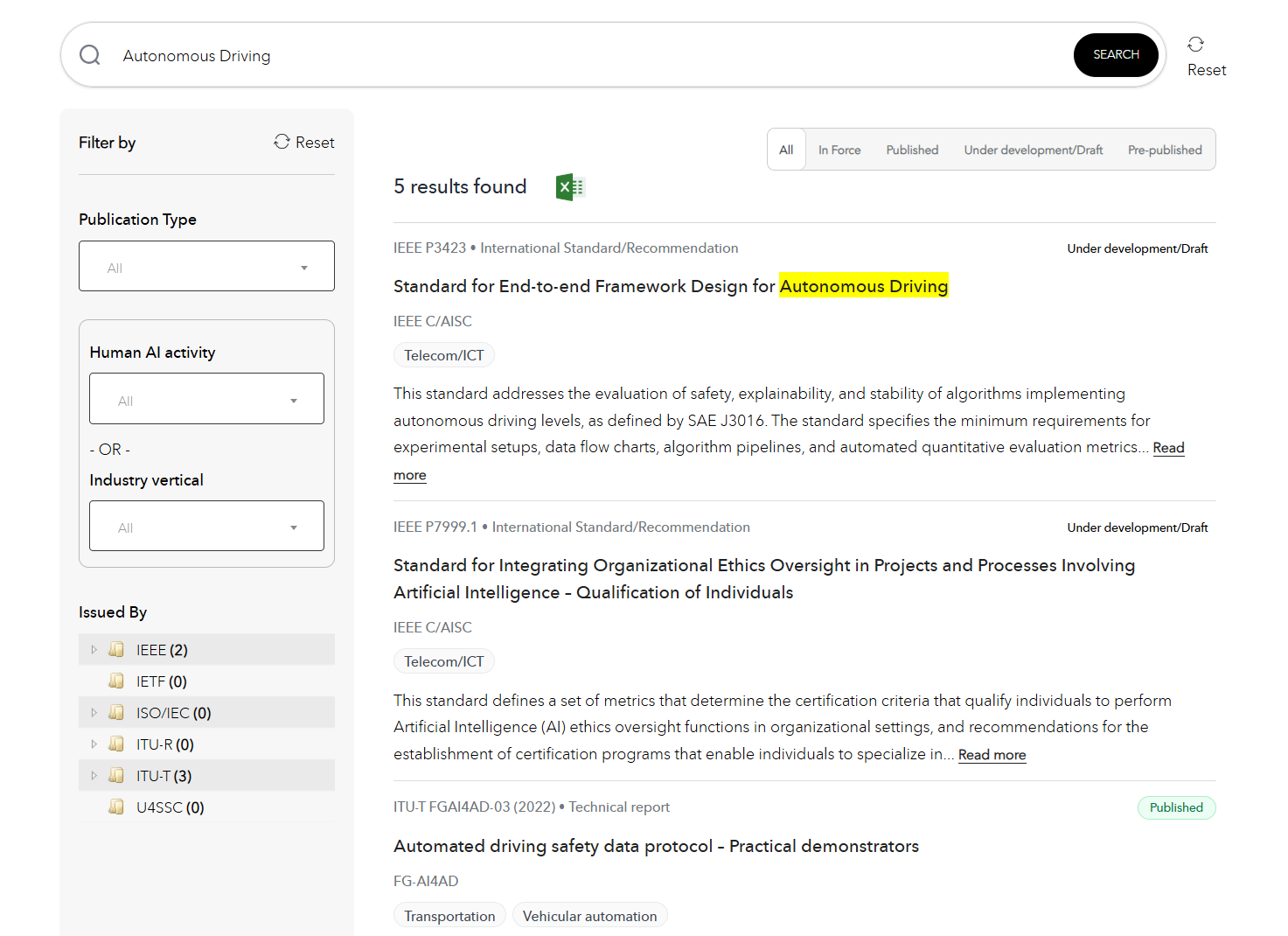
Users can search for information in the database using keywords. For a keyword search, the system will look for the specified information in the following database fields: title of the AI publication and the field description of the publication. 

See example below:
Keyword search

Figure 1: Keyword search

NB
After a keyword search is done, one should click on the Reset button before doing the next search.

How do I use the filters to refine my search?

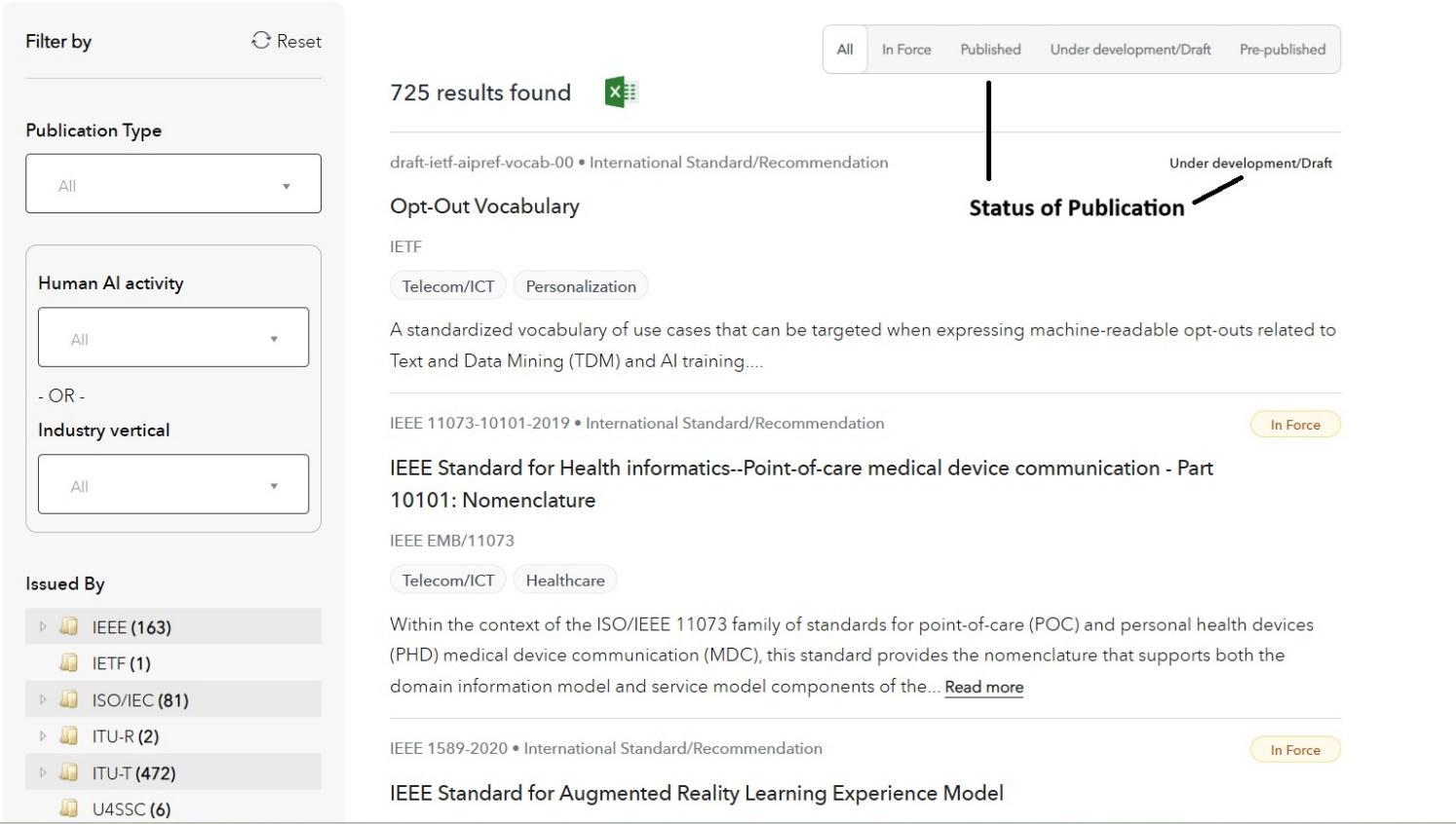
There are five (5) types of filters that can be used to mix and match to refine search (see image below). To conduct an advanced search, users can combine multiple filters to narrow down the results. This approach is particularly useful when looking for very specific publications or standards that meet certain criteria:

  1. Filter by Publication Type (publication types are explained in Section 2 above).
  2. Filter by Status (i.e. whether the publication is In force, Published or Under Development. 

Note: the use of In Force and Published vary by standards body

  1. Filter by Industry Vertical (ie by industry or economic sector such as healthcare, finance, telecom/ICT, retail, etc.).
  2. Filter by Human AI activity (The NIST Taxonomy of AI use is used to classify AI standards by usage and identifies the human activity that is automated by the AI system. The AI Use Taxonomy aims to provide a flexible means of classifying how an AI system contributes to an outcome. The taxonomy sets forward 16 AI use “activities” (i.e. Human AI Activity) which are independent of AI techniques and domains).
  3. Filter by using the field Issued By (i.e. the standards body which created the publication).  Note the field Issued By provides the listing of AI publications by standards body and their respective technical groups. .

The 16 types of Human AI Activity from the NIST Taxonomy of AI Use are shown below:

  1. Human AI Activity
  2. Content Creation
  3. Content Synthesis
  4. Detection and Response
  5. Digital Assistance
  6. Discovery
  7. Image Analysis
  8. Video Analysis
  9. Information Search/Retrieval
  10. Monitoring
  11. Performance Improvement
  12. Personalization
  13. Prediction
  14. Process Automation
  15. Recommendation
  16. Robotic Automation
  17. Vehicular Automation
Filters available for refining search

Figure 2: Filters available for refining search
Are you sure you want to remove this speaker?