

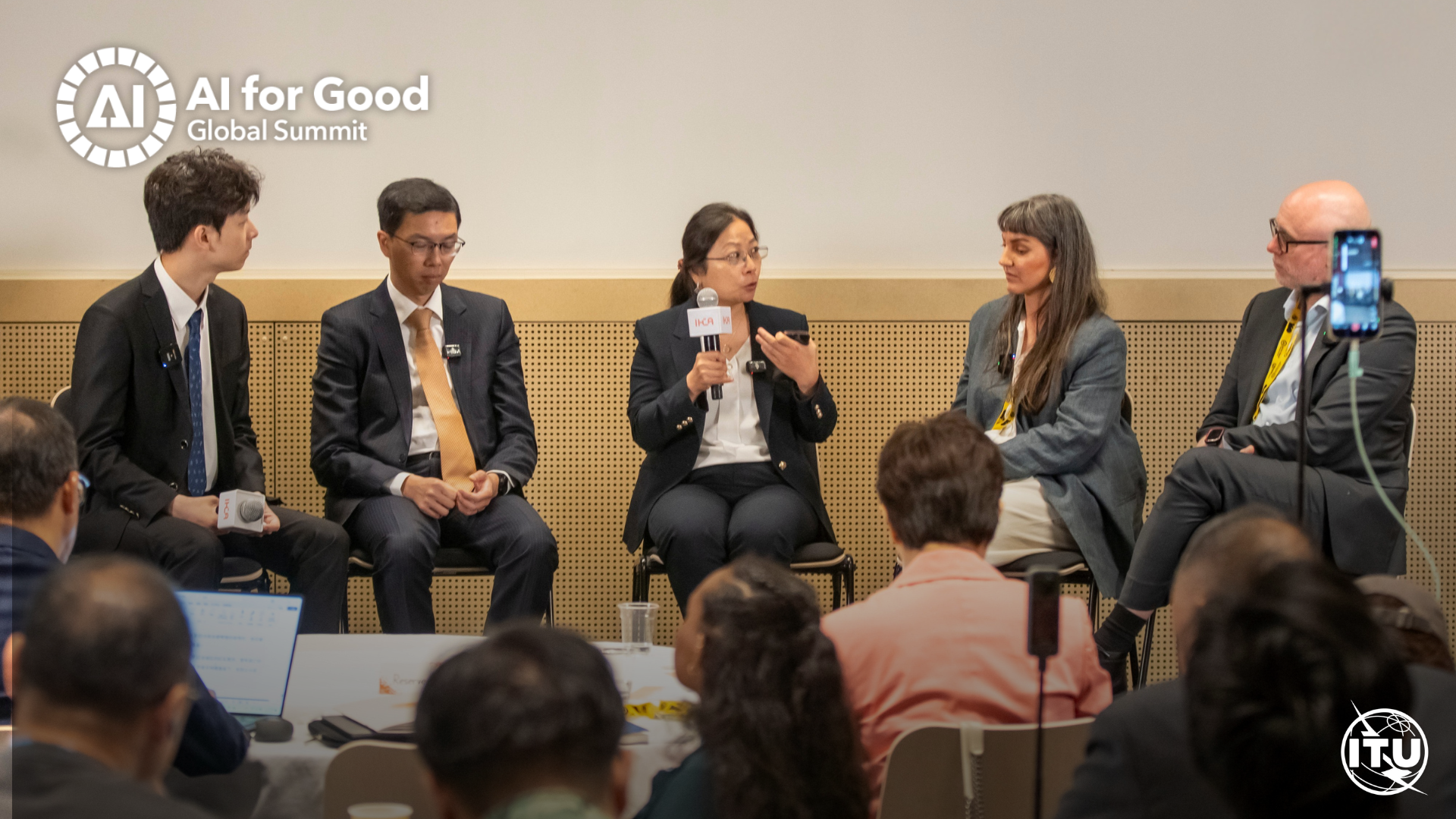
During the 2025 AI for Good Global Summit, the International Health Charity Association (IHCA) organized a workshop on empowering equal access to healthcare with AI. The discussion brought together leaders from academia, international organizations, technology companies, NGOs, and media to address a pressing challenge in global health: expanding mental health support for young people, particularly in under-resourced regions. The speakers highlighted both opportunities and risks, while underscoring the need for collaboration and human-centered innovation.
Exploring the role of AI in creativity and resilience
The session opened with Yang Lan, Founder and Chairperson of Sun Media Group and Sun Future Art Education Foundation. Drawing on her experience as a journalist and advocate for art education, she reflected on the intersection of technology, creativity, and mental well-being. Yang showcased projects that use AI to foster artistic expression and build psychological resilience among children, including those in rural China and children with autism. She emphasized that while concerns remain about whether AI replaces or enhances human creativity, the real value lies in how it can support connection and confidence.
“AI is empowering a democratization of art creativity, but it should help us to enhance the human connectivity instead of replacing human beings,” Yang said.
The importance of collaboration and compassion
Margaret Chan, Emeritus Director-General of the World Health Organization, addressed the audience through a video message. She stressed the need for international cooperation in applying technology to health challenges and praised IHCA’s vision. While acknowledging the transformative potential of AI, big data, and telemedicine, she reminded participants that these tools must always be guided by ethics and compassion.
“Technology alone is insufficient as it does not have a purpose or compassion. It is our responsibility to ensure that these powerful tools are utilized ethically, effectively, and equitably,” Chan said.
Education, stress, and mental health in a changing world
Yu Minhong, Founder and Chairman of New Oriental Education & Technology Group, spoke about the pressures young people face in education and the resulting mental health challenges. He described how rigid, exam-focused systems generate anxiety and depression among students. Yu explained how his organization is using AI to personalize learning, recognize emotional states, and provide support for students’ well-being. He outlined projects that combine education with psychological care, including AI-enabled emotional recognition systems and social skills coaching.
“AI must serve connections, not isolations. Using AI should never mean exposing children to cold screens,” Yu said.
Health systems, digital habits, and the future of care
Alex Ng, President of Tencent Healthcare, drew on his background as a clinician and public health expert to discuss the pressures facing China’s health system. He described the dual burden of chronic diseases and rising mental health needs, coupled with shortages of qualified professionals. Ng noted both the benefits and risks of China’s highly digital environment, from telemedicine access to online addiction. Tencent is developing AI-enabled platforms to improve efficiency for doctors and enhance empathy in digital mental health tools. He emphasized that the mental health tsunami is only barely starting with all the emerging trends and highlighted the need to engage communities early.
Watch the full session here:
Evidence-based approaches to digital interventions
Ken Carswell, Mental Health Specialist at the World Health Organization, presented WHO’s work on digital mental health interventions. He highlighted the treatment gap worldwide and the need for scalable solutions. Carswell shared evidence that self-help and guided digital tools can reduce depression and anxiety, including successful trials of chatbots and other interventions. He cautioned, however, that many commercially available tools lack testing and validation. “My main thing is really for us all to think about how we build the foundation for rigorous state-of-the-art research around AI,” he said, stressing the importance of collaboration among researchers, health professionals, and technologists.
Family communication and accessible support
Chen Xingjia, Founder of the Ever Care Charity Foundation and IHCA, spoke about the central role of family in adolescent mental health. He described how many problems stem not from a lack of love, but from gaps in communication between parents and children. To address this, his organization is developing the Qijia AI family mental health coach, designed to provide free, open-source, and professional guidance for families:
“We promised to be forever free so that no family is denied help for economic reasons,” he said, outlining his vision for universal access to mental health support through collaborative volunteer-driven networks.
Data, evidence, and the role of universities
Zhang Min, Vice Dean and Vanke Chair Professor at the Vanke School of Public Health, Tsinghua University, emphasized the need for high-quality data to make AI reliable in healthcare. She explained how her research uses large clinical datasets to derive insights that support decision-making. Zhang noted that many AI tools today are based on limited or biased data, raising concerns about generalizability. She emphasized that without comprehensive and high quality and representative data, AI tools cannot perform reliably across different settings; highlighting the responsibility of universities to advance rigorous research and causal inference methods.
Youth-centered design and ethical guidelines
Karina Rios Michel, Chief Creative and Technology Officer at Girl Effect, shared her organization’s work in designing AI-powered chatbots for teenagers in Africa and Asia. She explained how Girl Effect co-creates products with young people to ensure cultural and emotional relevance, reaching millions of users through familiar platforms like WhatsApp and Facebook Messenger. Rios also described the organization’s development of practical ethical guidelines for AI in youth mental health, created in collaboration with experts and tested with young people themselves.
“AI is really powerful, but we want everyone to be aware and learn from Girl Effect on the things that we discovered in our journey,” Rios Michel said.
Bridging perspectives in dialogue
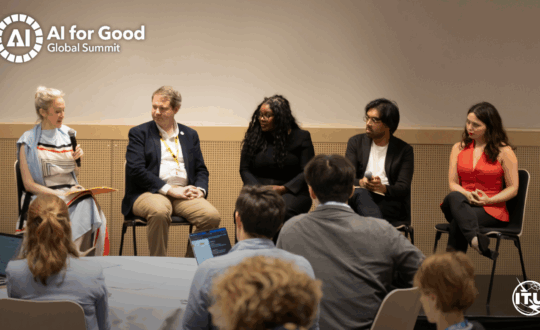
The session concluded with a roundtable discussion among the speakers, where they reflected on opportunities and challenges in expanding access to mental health care through AI. Participants noted the promise of AI in improving access and personalization, but also acknowledged barriers such as unequal data representation, limited research, and disparities in access across regions. They highlighted the importance of keeping human well-being at the center of innovation, ensuring that AI complements rather than replaces human relationships.
The speakers collectively emphasized that AI must be developed and deployed with responsibility, inclusivity, and compassion. The session underscored the urgency of addressing youth mental health worldwide while also showing pathways for collaboration between governments, NGOs, academia, and the private sector. Likewise, it brought forward the shared commitment to build a healthier and more equitable future.