

“Where is the love?” is a question he has been asking throughout his career, will.i.am told the audience in his closing remarks. He argued that as machines increasingly out-think and out-reason humans, the answer lies in what makes people distinct from those systems: humans are not logical, but emotional and compassionate creatures, and that capacity for empathy, tolerance and collaboration is what will be needed to solve problems that “greed has always ignored.”
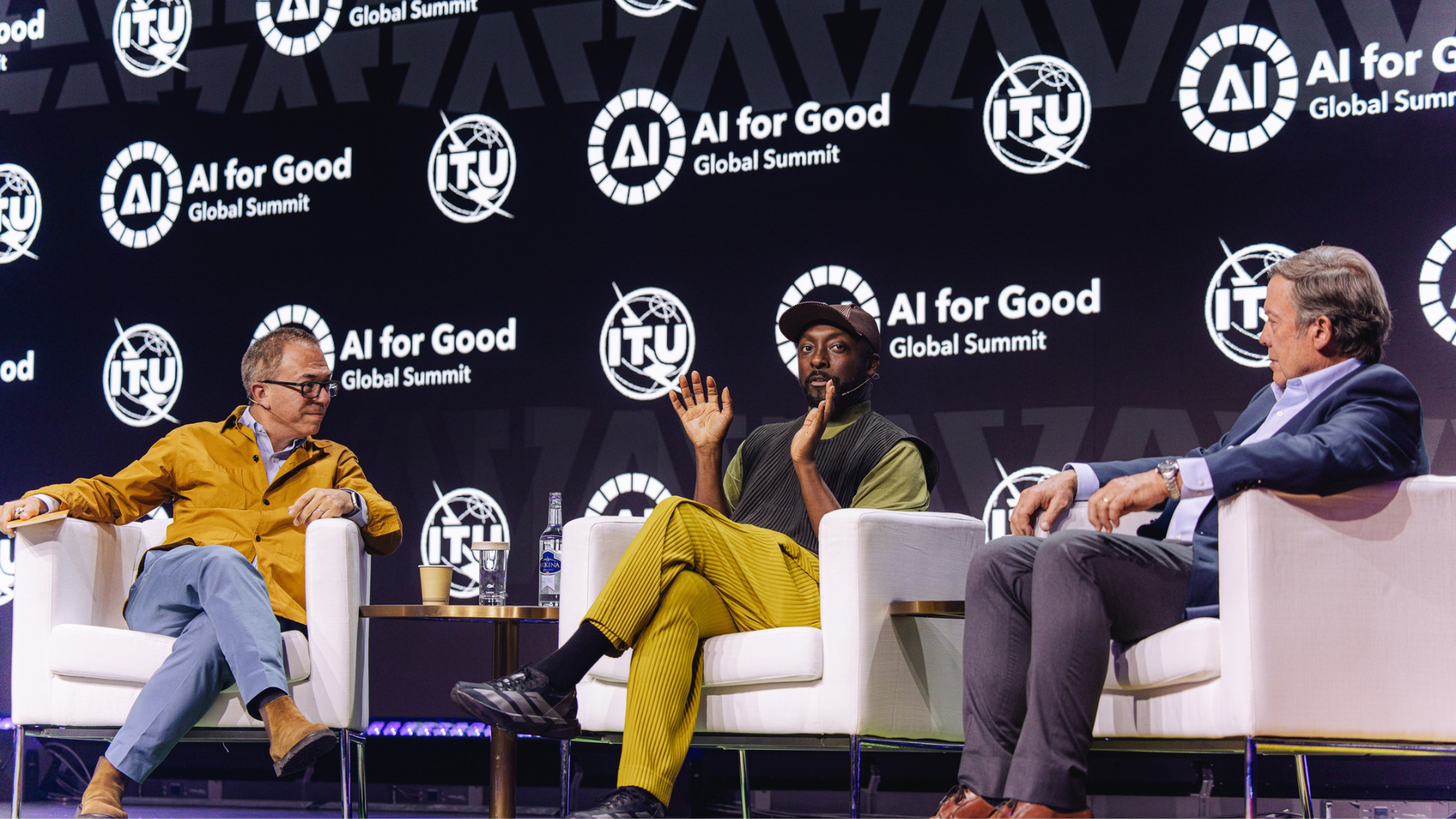
The remarks concluded a session titled “The First AI Generation: Are We Learning the Right Way?”, which included will.i.am and Michael Crow and was moderated by Kenneth Cukier, deputy executive editor of The Economist.
Michael Crow
For twenty-four years, Michael Crow, academic leader, designer of knowledge enterprises, scholar of science and technology policy, and the sixteenth president of Arizona State University, has established an institutional model centred on a single principle: inclusion. This model is defined as a learning and creative environment designed around students, with world-class faculty members available to a wide range of individuals. He said achieving that requires dismantling structural resistance to innovation and new technology. ASU’s unconventional academic divisions, such as schools dedicated to space exploration, human evolution, ocean futures, and conservation, are founded on a philosophy he described as shared by all: the empowerment of the learner.
“You’re not going to measure the success of the institution by how many people you don’t admit,” Crow said. “You’re going to measure the success of the institution by what you produce, the empowerment of the learner.”
will.i.am
will.i.am, the musician and founder of several AI startups, offered an alternative viewpoint on the future of education. He said music transformed his life and his family’s economic circumstances, describing it as the way his family escaped poverty.
“I’m a musician because of the computer,” he said. Software, not a conventional instrument, was his entry point into music, he said. He traced that trajectory back to primary school, where a robust science curriculum and early exposure to a computer lab inspired an enduring interest in technology.
Crow said the primary function of AI in education is to improve, not to replace, teaching and learning, thereby transforming educators into “knowledge navigators.” At present, there are approximately 8,000 AI-related initiatives in progress at ASU. Responding to concerns that AI could facilitate cheating, Crow said:
“The individual who cheats will be an individual who falls behind.”
If an assessment can be defeated using AI, he said, it is “the wrong test.”
Asked how he applies the technology to support learning rather than enable misuse or, as he put it, cognitive surrender, Crow pointed to AI’s role in making language instruction faster, more affordable and more effective. He cited Dreamscape Learn, a virtual-reality platform that immerses students in simulated environments, such as inside a living organism or an alien ecosystem, as part of biology coursework.
Addressing whether full technological integration can coexist with the growing “device-free” movement in education, built around a “cloister” model of learning, Crow expressed no objection to institutions selecting a digital-free approach. However, he opposed treating it as the sole legitimate approach, contending that this would impede future advancements. He described the human brain as “the most complex object in the known universe,” one that should be empowered rather than shielded from innovation and said the two approaches can coexist. Framing it as a conflict between methodologies, he added, is “silly.”
will.i.am offered a related view, using music as a reference point. He noted that a segment of musicians will always dedicate themselves to mastering a single instrument and performing live, because audiences continue to value human performance. He contended that both human-only and human-AI collaborative work should be acknowledged on their own terms, a dynamic he anticipates will be extended to education. “The same would be for education,” he said.
Does education’s core function need to change now that machines can supply answers instantly? Crow argued the shift is less significant than it may appear. Referencing John Dewey, he said, “the key is not the answer,” adding that his focus when using AI is the quality of the question posed to the system, not the answer it returns.
will.i.am extended the point, describing a course he teaches at ASU, The Agentic Self. It originated, he said, from a direct provocation: as companies replace employees with AI, he questioned how humanity could be substituted by machines “when humans have invested 10,000 hours and the AI has no lived experience.” In the course, students are required to build AI agents modelled on their own personal interests.
Throughout their careers, both Crow and will.i.am have been confronted with sceptics who have categorically rejected their ideas. On how they overcame the scepticism and remained steadfast in their vision, each gave a different answer.
Crow’s response centred on purpose: “what do you want your life to mean? Each of us should have this meaningful thing that we’re we’re attempting to do. And I don’t mean big or fanciful or becoming rich or things like that. I think something meaningful. And you need to figure out what that is for you and then drive yourself toward that.” For him, this entails the establishment of an organization capable of assisting each individual in realising their full potential.
will.i.am’s response centred on a different concept: harmonious love, the idea that one’s actions should bring happiness to oneself and others without disturbing those nearby. He likened it to playing in an orchestra: you enter arrogantly and off-rhythm, and all you produce is noise.
He returned to the same theme in his closing remarks, repeating a question he said he has been asking throughout his career: “Where is the love?”