

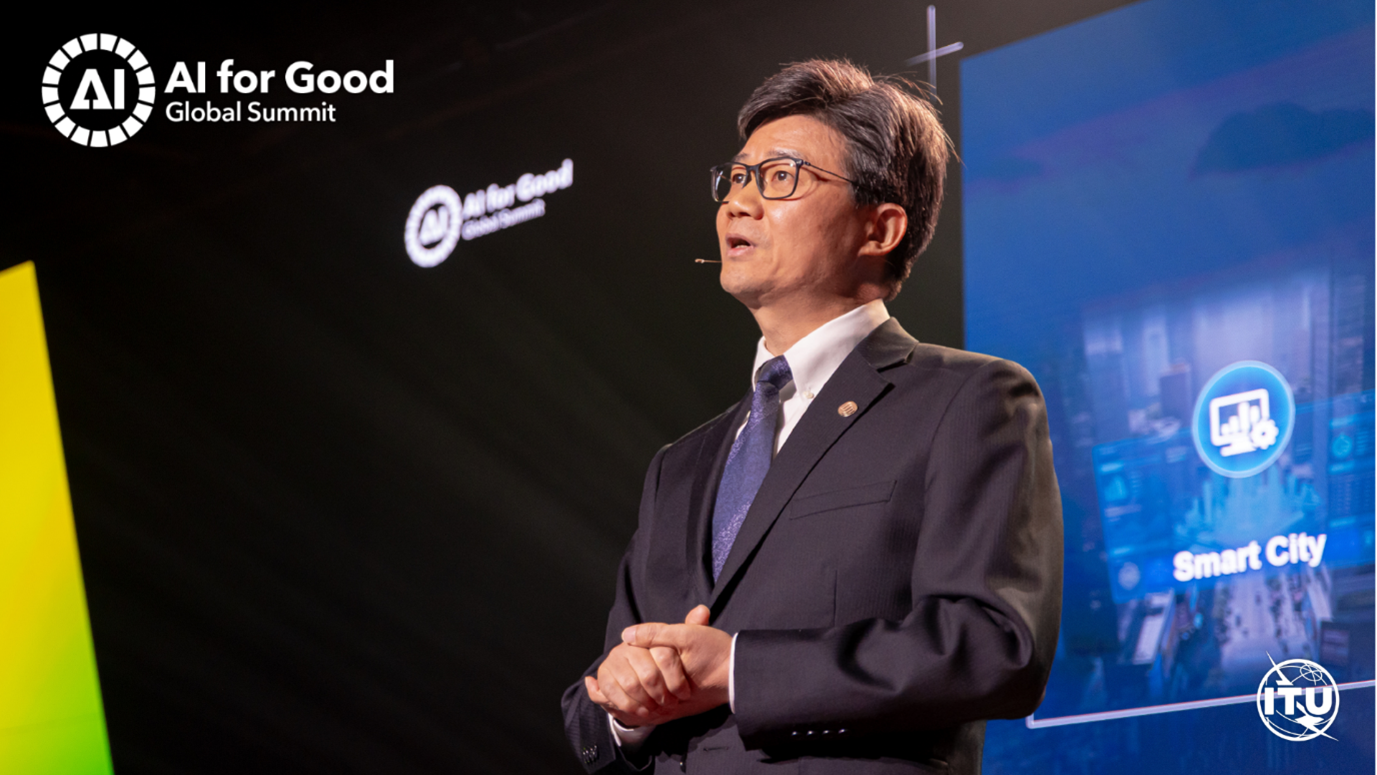
At the 2025 AI for Good Global Summit, He Biao, CEO of China Mobile Communications Group Co., Ltd., presented China Mobile’s vision and practical initiatives around AI for LPG – life, production, and governance. His speech focused on how AI can be developed and deployed not just for technological advancement, but as a global public good aimed at benefiting humanity.
He began by acknowledging the rapid development of AI over the past year, calling it a key driver of sustainable development.
“Over the past year, AI has rapidly developed, emerging as a key driver of sustainable development and unlocking new pathways to tackle global challenges,” he said.
Representing China Mobile, he introduced the concept of AI for LPG as part of a broader strategy to bring the benefits of AI to all levels of society and industry.
Entering the “AI+” era
AI is becoming a strategic engine for both technological revolution and industrial transformation, ushering in what He described as the “AI+” era.” “‘AI for Science’ is emerging as a new research paradigm, accelerating breakthroughs in emerging technologies,” he said. He characterized this shift as one that is reshaping the domains of life, production, and governance, and opening up historic opportunities for global sustainable development.
He first elaborated on the role of AI in life. AI is transforming how people live, through the use of AI agents that function as personalized assistants. These agents integrate the knowledge graph of human society and real-time data streams to offer cognitive capabilities and intelligent services.
In daily life, AI is transforming how people access and consume information through AI agents, personalized assistants that integrate the full knowledge graph of human society with real-time data streams.
“AI agents build cognitive agents with self evolution capabilities and upgrade intelligent services to enable everyone to have an AI personal assistant to meet the personalized and diversified information consumption needs,” He said.
Such systems are becoming increasingly embedded in everyday life, from smart devices to vehicles with autonomous features, and embodied robots, contributing to a more intelligent and accessible living environment.
Transforming production with AI and DICT
In the production sphere, AI is increasingly integrated with digital information and communication technologies, known as DICT, to reshape manufacturing and industrial systems. “DICT represents the integration of digital information and communication technologies,” he said, describing it as the new form of information services that now integrates into the full production process.
This integration is giving rise to innovations such as digital twins, flexible manufacturing, and hybrid human-robot teams. These approaches are accelerating cross-sector collaboration, enabling the growth of new industries, and supporting the digital transformation of traditional ones.
View the full session here:
Reimagining governance with intelligent systems
In the area of governance, He highlighted the increasing integration of AI into social structures and operations.
“AI is deeply integrating into social organizational structures and operational systems, expanding new governance scenarios such as smart cities, smart communities, and digital villages,” he said.
This integration is expected to improve the efficiency of resource allocation and support more scientific approaches to decision-making. He also pointed to the future emergence of “silicon-based life,” defined as entities composed of physical hardware, sensors, processors, and cognitive systems, a development that could lead to profound societal shifts.
Looking forward, He described a future of “human AI co-governance,” where AI systems and human decision-makers work in tandem to manage complex environments and public services.
China Mobile’s infrastructure for AI
China Mobile is positioning itself as a central player in the development of AI, aiming to be what He called a “shaper, taker and facilitator of AI+.” As a leading innovator in digital technology and information services, the company is focused on building a comprehensive AI infrastructure that includes computing power, data, models, and platforms.
“We are committed to building comprehensive AI infrastructure encompassing computility, data, models, and platforms,” He stated.
One of the foundational concepts driving this strategy is a notion He referred to as “computility,” a blend of computing and utility, which he described as the delivery of computing power as a utility service.
Built on this foundation, China Mobile is promoting applications that turn AI innovation into inclusive public goods, with the goal of ensuring that the dividends of technological progress benefit all households more intensively and equitably.
“AI for life” through smart applications and terminals
He described a multi-scenario service system developed by China Mobile to support AI for life. This system integrates AI agents, applications, and terminals to offer improved digital experiences. One example is an AI agent named LingXi, deployed across the China Mobile app, smart devices, and home hubs.
“LingXi […] provide[s] diversified functions including information services, audio–visual entertainment and content generation, enabling everyone to activate the AI companion instantly,” He said.
Existing services have also been upgraded with AI-driven features, including video ring back tones, 5G new calling, and cloud computing. AIGC-enabled video ring back tones now offer one-click content generation, AI avatar interaction, and intelligent song composition.
China Mobile is also expanding access to AI-powered terminals, such as connected vehicles and home robots. Its smart cockpit service integrates personal, household, and vehicle data to deliver capabilities like voice interaction, vehicle health monitoring, collision alerts, and route planning, supporting what He called “driver vehicle integration and pioneering a new era of intelligent connected mobility.”
“AI for production” with scalable models
In the production domain, China Mobile focuses on demand-driven AI innovation and supports digital transformation across industries. Its “AI+ DICT” solutions combine artificial intelligence with digital information and communication technologies to deliver integrated solutions tailored to specific scenarios. At the core of this approach is the Jiutian family of large language models, which includes more than 40 models developed for industry-specific use.
These models are deployed at scale internally, supporting functions such as network management and customer service, while externally, they are used to optimize enterprise operations.
One application example is a hydrological AI model that integrates satellite remote sensing and IoT technologies for 3D basin-wide monitoring. It enables predictive analytics of water dynamics to support flood control and disaster resilience in river basin communities.
To further streamline deployment, the company has developed a model-as-a-service (MaaS) platform that includes over 100 mainstream models and more than 1,000 AI agents. The platform provides end-to-end support for model training, tuning, and deployment, allowing enterprises to build and deploy optimized AI solutions efficiently.
Collaboration plays a central role in strengthening China Mobile’s AI ecosystem.
“We have established AI training, evaluation and industry innovation labs through collaborative frameworks such as joint laboratories and joint innovation centers,” He said.
These efforts are designed to improve infrastructure interconnection, enable the sharing of core capabilities, and support the co-creation of AI applications.
One notable partnership involves a joint AI laboratory with the Sinar Mas Group, created to support Indonesia’s digital transformation. This collaboration has led to the development of Indonesian language foundation models and the deployment of AI-powered customer service applications.
“AI for governance” through cities, communities, and villages
China Mobile’s work on AI for governance is supported by a multi-tier information infrastructure. Among them is the “intelligent brain of cities,” a system designed to collect and process urban data to enhance public safety, emergency response, and urban management.
The company has also introduced an AI-powered community governance platform. “Our AI community assistants provide residents with accessible services including policy consultation, procedure guidance and case resolution,” He explained, noting how such tools improve day-to-day service delivery and enhance residents’ sense of well-being and security.
In rural areas, a digital village platform offers services for village affairs management, regional governance, and public convenience. The aim is to support rural revitalization while upgrading local governance, moving from “safety to health and then to beauty.”
In addition, China Mobile is also applying AI to support ecological and environmental governance. AI and 5G technologies are being used to advance green development goals and reduce environmental impact.
One example is a conservation initiative for rare marine animals, supported by an intelligent supervision platform built on 5G advanced technologies and AI models. This platform includes capabilities such as electronic fencing, violation alerting, and intelligent decision-making support, all aimed at improving the effectiveness and efficiency of marine wildlife protection.
A call for global collaboration
He closed the talk with a reflection on the global mission of AI innovation.
“The innovative development of AI carries the common mission of benefiting humanity,” he said.
He emphasized the need for consensus, cooperation, and shared standards to ensure that AI becomes a global public good.
“We realize that only by building a global consensus, deepening global collaboration and forging AI as a global public good to benefit humanity can we fully release the deployment potential of AI,” he stated.
China Mobile, he added, will support international efforts such as the Global AI Governance Initiative and the Shanghai Declaration, contributing what he described as “Chinese wisdom and solutions” to address global challenges.
Five proposals for the global community
To close his speech, He Biao presented five proposals for advancing global collaboration on AI. First, he called for upgrading information infrastructure through improved global connectivity. This includes accelerating the evolution from 5G to 5G Advanced, enhancing the layout of global data centers, and promoting safer and more trustworthy cross-border data flows.
Second, he emphasized the importance of fostering innovation through international collaboration in AI research and development. This includes integrating computational resources, breaking through core capability bottlenecks, and promoting synergy between AI and emerging technologies such as 6G.
The third proposal focused on strengthening talent cultivation. He urged the global community to embrace a people-centered approach by enhancing AI education, improving international talent development mechanisms, and accelerating the training of AI-native and interdisciplinary professionals.
Fourth, He pointed to the need for inclusive applications, encouraging the development of user-friendly AI tools that respect cultural and linguistic diversity and help close digital divides across countries and regions.
Finally, he stressed the importance of safety in AI governance. He called for robust governance frameworks, strengthened risk prevention systems, and international standards aligned with shared human values.
He ended with a reflection on shared purpose: “As an old saying goes, nothing, not even mountains and oceans can separate the people with shared goals and visions.”
 Badge available